Echo Cancellation vs Noise Reduction: What’s the Difference?
A practical guide for meetings, calls, and speech cleanup explaining what echo cancellation solves, what noise reduction solves, and when each one should come first.
Browser Noise Removal
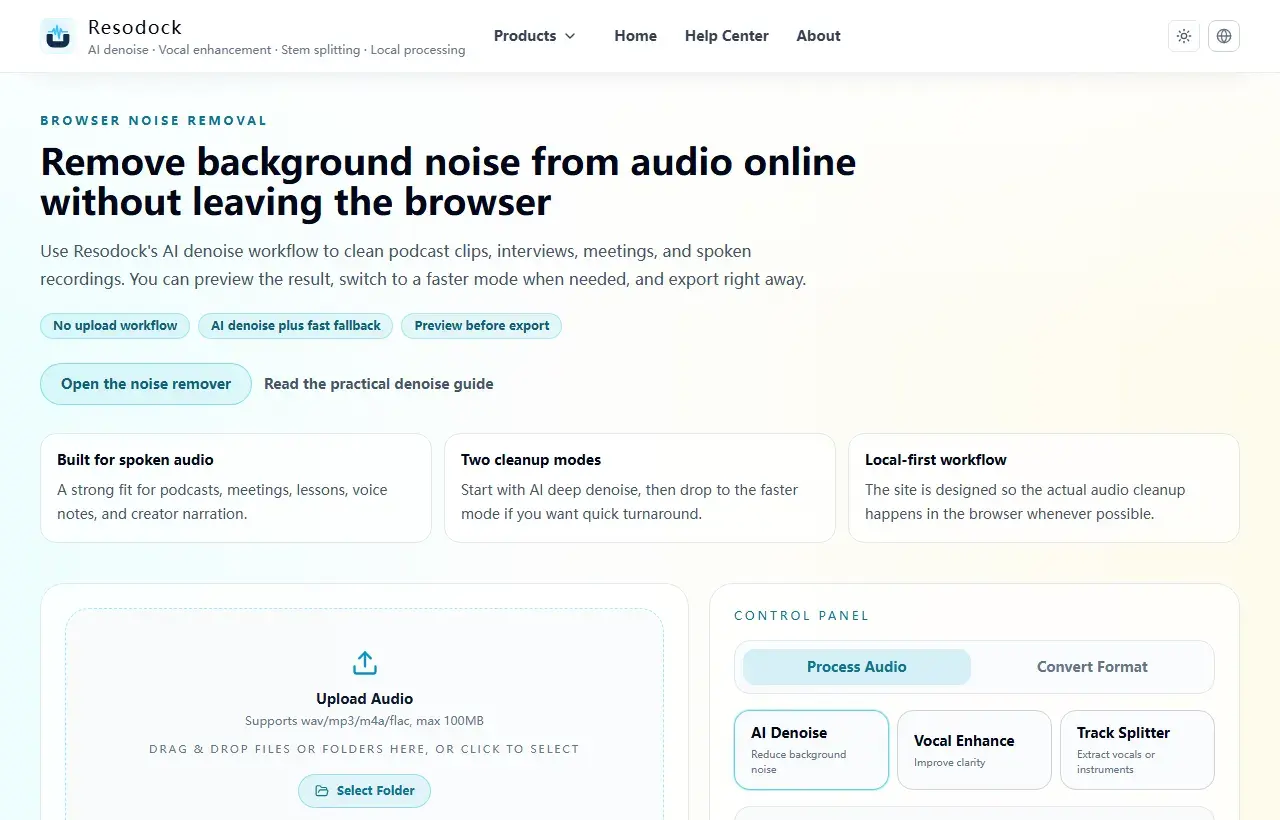
Remove background noise from audio online without leaving the browser
Remove background noise from audio online without uploading files. Clean podcasts, interviews, meetings, and voice recordings directly in your browser.
Echo cancellation and noise reduction are not the same job
Echo cancellation is mainly for repeated reflections, hollow room sound, speaker bleed, and call-path echo. Noise reduction is mainly for steady background sounds such as fan noise, air-conditioning hum, hiss, and other constant environmental noise.
Both belong to audio cleanup, but they target different failure modes. Treating echo like noise, or treating noise like echo, often creates unnatural results.
Try it now
Run a short pass in the noise remover
If this article matches your recording, process 15 to 30 seconds first. Listen to the before-and-after result, then decide whether to clean the full file.
- 1Open the noise remover and go to the upload area.
- 2Click the upload box or drag the recording into the page.
- 3Keep AI denoise selected, then start processing.
- 4Compare before and after. If the voice still sounds natural and the noise is lower, download the result.
What echo cancellation is meant to fix
Echo cancellation is common in meetings, video calls, streaming, and remote recordings. Its goal is not to make a room silent. Its goal is to reduce the repeated, distant, hollow, bouncing quality that makes speech feel less direct.
If a recording sounds like the microphone was too far away, the room is hard and reflective, or each phrase has a light slap-back feel, echo handling usually matters more than raw denoise.
What noise reduction is meant to fix
Noise reduction is the better match for steady background sounds such as computer fans, AC noise, hiss, electrical hum, or continuous room noise. These problems tend to sit under the voice instead of reflecting it.
If the main problem is a constant layer of unwanted sound, denoise should usually come before any echo-focused processing.
Which one should come first?
If the most obvious problem is room bounce, hollowness, or distant speech, start with echo cancellation or reverb reduction. If the most obvious problem is a constant noise floor, start with noise reduction. Some recordings have both, especially meetings, and then the best workflow is usually to reduce the dominant issue first and keep the second pass lighter.
The goal is not to max out every control. The goal is to solve the problem that hurts intelligibility the most, in the right order.
The simplest difference in one sentence
Echo cancellation handles reflected or repeated voice energy, while noise reduction handles steady unwanted background sound.
If you are unsure, ask this: does the file sound hollow and bouncy, or does it sound like there is a constant hiss or hum underneath? That answer usually tells you which process to prioritize.
Summary
Before cleaning audio, identify the main problem: steady background noise, echo, wind, or distance from the microphone. Each one needs a different touch.
A short 15 to 30 second test is the safest start. If the voice still sounds natural, continue with the full file or add light voice enhancement only when needed.
Related Articles
Noise Removal
Remove Background Noise From Video Online: Extract Audio, Clean It, and Export
Video noise cleanup usually starts by pulling out the sound. Test 15 to 30 seconds first, make sure the voice still sounds natural, then process the full clip.
Noise Removal
How To Remove Background Noise From Audio Online Without Uploading Files
This guide tells you when to use AI denoise, when fast mode is enough, and how to download the result.
Noise Removal
How To Fix Echo And Reverb In Zoom Recordings
This guide is optimized for meeting speech: clearer voices without over-processing artifacts.
FAQ
Can echo cancellation also remove background noise?
Not completely. Echo cancellation mainly targets reflections and repeated voice energy, not steady noise floors.
Can noise reduction also fix echo?
Usually not well. Noise reduction is stronger for constant background sound than for room bounce or hollow reflections.
What if a meeting recording has both echo and background noise?
Identify which problem hurts intelligibility more, solve that first, then use a lighter second pass on the other issue.
Why can processed speech end up sounding dry or strange?
The usual reason is too much processing or the wrong order. Solve the dominant problem first, then polish lightly.